
Last Updated: November 8, 2026
Quick Summary
Vegan meal planning is worth the cost only when the time it saves and the waste it prevents exceed the subscription fee. A paid plan buys structure that removes daily decisions, but it cannot fix a kitchen you do not want to cook in. Run the break-even math on your own grocery receipts before you subscribe.
- A paid plan bundles a rotating menu, a consolidated grocery list, and nutritional guidance.
- Score each tool on recipe variety, list consolidation, nutrition tracking, customization, and support.
- Build your weekly total from pantry staples, fresh produce, protein sources, and extras.
- The true weekly cost includes groceries, pantry restock, supplements, food waste, and delivery fees.
- Test one self-directed week of five dinners before committing to any subscription.
Table of Contents
- What a Paid Vegan Meal Plan Actually Delivers.
- The Vegan Meal Planner Lineup: Free Versus Paid Tools.
- What a 7-Day Vegan Meal Plan With Grocery List Really Costs.
- Building a Vegan Meal Plan High Protein Without Overspending.
- Is Vegan Meal Planning Worth the Cost for Weight Loss?
- Start With One Week Before You Commit.
- Frequently Asked Questions
What a Paid Vegan Meal Plan Actually Delivers.
Vegan meal planning is the practice of mapping out plant-based meals in advance, and paying for it buys one thing above all: a structure that removes daily decisions. Whether that structure is worth the cost depends on how you value your time and how often good intentions collapse at 6 p.m. Many readers who have tried free recipe blogs give up within a month, not because the recipes failed but because nobody told them what to cook on a Tuesday.
A paid plan typically bundles three components: a rotating menu, a consolidated grocery list, and some form of nutritional guidance. The menu saves decision fatigue. The grocery list saves duplicate shopping trips. The guidance is where quality varies most, so read the sample week before you subscribe to anything.
The honest limitation: no plan fixes a kitchen you do not want to cook in. If you dislike cooking, a subscription adds a bill without adding motivation.
The Vegan Meal Planner Lineup: Free Versus Paid Tools.
Free tools win on price and lose on coherence. A recipe blog gives you dinner ideas but no weekly arc, no shopping consolidation, and no portion logic. Paid planners generally offer less choice and more structure. The table below summarizes how the main options compare on the features that actually affect your week.
| Option | Cost Model | Weekly Menu | Grocery List | Nutrition Guidance | Best For |
|---|---|---|---|---|---|
| Free recipe blogs | No cost | No | No | Rarely | Inspiration only |
| Eat This Much | Subscription | Yes | Yes | Macro targets | Macro-focused eaters |
| Prospre | Subscription | Yes | Yes | Macro targets | App comparison shoppers |
| Cronometer | Free tier plus paid | Partial | No | Micronutrient tracking | Nutrient detail |
| Mealime | Free tier plus paid | Yes | Yes | Diet settings | Allergy exclusions |
| Vegan Lifestyle Pro | Membership | Yes | Yes | Curated guidance | Comfort-food cooks |
Two gaps stand out. First, most apps optimize for macros, not for whether the food tastes good enough to repeat. Second, few publish a full sample menu before purchase. Ask for one.
A feature grid is not a decision, though, so score each tool against the five things that actually change your week. Recipe variety tells you whether you will still be cooking from the plan in week six. Shopping list consolidation tells you whether you save a second trip. Nutrition tracking tells you whether the plan accounts for iron, B12, and calcium rather than only calories. Customization tells you whether allergies, leftovers, and cooking skill are handled. Support tells you whether a human answers when the plan breaks.
The break-even question is simpler than the feature grid. A subscription only pays for itself if the time it saves and the waste it prevents exceed the fee. A paid plan can reduce the time spent on weekly planning and the number of extra grocery trips, and how much it saves depends on the household.
USDA FoodData Central nutrition database is a useful free cross-check for anyone verifying the nutrition claims behind an app’s targets.
When comparing tools, confirm whether the grocery list is included before you build a week around it.
What a 7-Day Vegan Meal Plan With Grocery List Really Costs.
A 7-day vegan meal plan with grocery list costs whatever your pantry gap is, and that number swings widely by household size and how much you already stock. The plan itself is the cheap part. The groceries are the real line item, and they repeat every week.
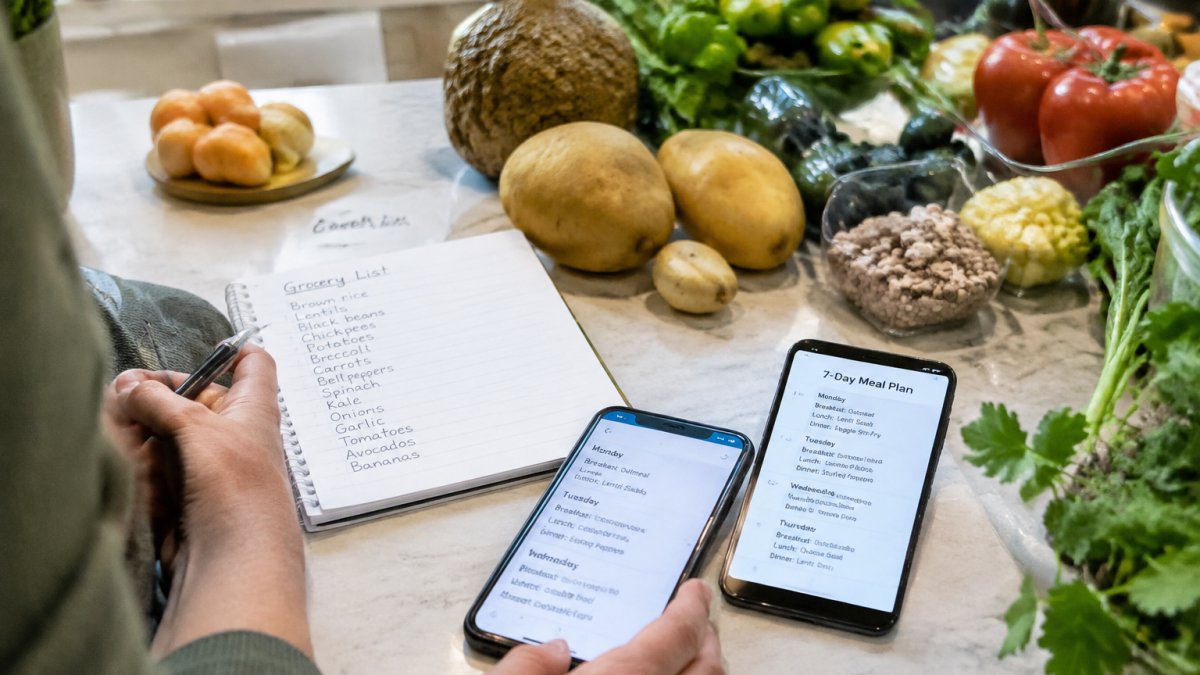
Build the weekly total from four buckets: pantry staples you buy occasionally (rice, lentils, oats), fresh produce you buy weekly, protein sources, and extras like plant milk or sauces. Households that cook from staples generally spend less per plate than households buying prepared vegan items, because prepared food carries labor costs.
The total-cost-of-ownership view is where most budgeting advice stops short. A realistic weekly figure includes five lines, not one. Groceries are the visible line.
Household size changes the math more than any other variable. A single cook can run a tight week from a small staple base and a short produce list, and the per-plate cost falls further when leftovers carry into lunch.
Watch out: the most common budgeting mistake is buying a full week of fresh produce on day one. For a deeper look at where the money actually goes, read our breakdown of the 7 real costs of vegan family life and how to cut them.
Building a Vegan Meal Plan High Protein Without Overspending.
A vegan meal plan high protein does not require protein powder, and it certainly does not require the priciest products on the shelf. It requires anchoring each meal to a cheap legume or grain and building around it.
- Lentils: cook fast, cost little, work in soups and sauces.
- Canned or dried beans: the backbone of tacos, bowls, and stews.
- Tofu and tempeh: buy plain, season yourself.
- Whole grains: brown rice, oats, and whole wheat pasta add protein alongside carbs.
- Seeds: sunflower and pumpkin seeds lift a meal’s protein for cents.
Plan two protein anchors per day and you stop thinking about it. Our guide on how to get enough protein vegan covers portion math in more detail, and our quick plant-based meals for busy families is built for exactly this constraint.
Is Vegan Meal Planning Worth the Cost for Weight Loss?
Vegan meal planning is worth the cost for weight loss only if the plan controls portions, not just ingredients. Plant-based eating is not automatically calorie-light; oils, nut butters, and refined carbohydrates add up quickly.
What a paid plan genuinely helps with is repetition. A fixed weekly menu removes the improvisation that leads to larger portions and unplanned snacks. That is a behavioral benefit, not a nutritional one, and it is the honest reason planning supports weight goals.
If you use protein powder to hit targets, read our guide to choosing the best vegan protein powder before you buy, since cost per serving varies enormously between products.
Start With One Week Before You Commit.
One week of self-directed planning tells you more than any comparison table. Pick five dinners, write one grocery list, and cook them. If the week feels manageable, a paid plan will compound that habit. If it feels like a chore, no subscription will rescue it.
That trial week is also where Vegan Lifestyle Pro earns its place. Vegan Lifestyle Pro pairs plant-based comfort food recipes with practical guidance for beginners and seasoned vegans alike.
Ready to test it properly? Browse our quick and easy vegan recipes to fill your first week, then decide.
The real question is not whether planning costs money but whether the alternative costs more in wasted groceries and takeout. If you want recipes built for repeat cooking and guidance that respects your time, Vegan Lifestyle Pro is the place to start. Get started with Vegan Lifestyle Pro and turn one trial week into a routine that holds.
Frequently Asked Questions
What does a paid vegan meal plan include that a free one does not?
Paid plans usually add structure a free recipe blog cannot: a full week of meals mapped to a grocery list, portion and calorie targets, and filters for allergies or foods you dislike. Free options like recipe sites and basic apps cover individual dishes well, but you do the assembly work yourself. The trade is money for time and consistency. If you already enjoy planning and cooking, free tools may be enough. If planning is the step that keeps failing, a paid plan earns its place.
Can meal planning help reduce grocery spending on a vegan diet?
Yes, mostly by cutting food waste and impulse buys. A written plan and a matching grocery list keep you from buying produce that spoils before you cook it, which is where a lot of vegan grocery money disappears. Planning around cheap staples such as beans, lentils, brown rice, and potatoes also stretches the budget. The savings are real but modest, and they come from the planning habit itself, not from the subscription. A paid plan only pays for itself if it keeps you planning.
Can you get enough protein from a budget vegan meal plan?
You can. Lentils, beans, tofu, tempeh, and whole grains deliver solid protein at low cost per serving. The practical move is to build each meal around one protein source rather than treating protein as an afterthought. A high-protein vegan meal plan typically hits daily targets by stacking these foods across breakfast, lunch, and dinner. If you track closely, a nutrition app helps confirm you are meeting your target. For most people, consistency matters more than precision.
Is a vegan meal plan worth it for weight loss?
It can be, because weight loss depends on eating balanced meals you will actually repeat, and a plan removes the daily decisions that lead to takeout. A structured plan with calorie or portion guidance makes it easier to stay in a deficit without guessing. That said, no plan does the work for you. The value comes from following it long enough to build habits. Try a free week first, track how often you stick to it, and then decide whether paying adds enough consistency to justify the cost.
